Open the Flipkart app on any random weekday and you will see a banner screaming about a sale. Not a big one, just some routine “Daily Deals” push notification trying to get you to add one more thing to your cart. That single habit, the constant push to buy, tells you almost everything about how this company thinks and where it is headed. Flipkart did not become India’s biggest homegrown e-commerce name by accident. It built a business on scale, on logistics that actually work in a country where pin codes sometimes lead to a field instead of a house, and on a level of trust that took years of reliable delivery to earn. But 2026 is a very different year from 2014, when Flipkart was still the scrappy startup fighting Amazon with nothing but grit and Bansal-family ambition.
Today Flipkart sits under the Walmart umbrella, competes with Amazon India, Meesho, Reliance’s JioMart, and a hundred category-specific apps that are all trying to eat a slice of its pie. Quick commerce has changed what “fast delivery” even means. Ten minutes is the new normal for groceries, and Flipkart Minutes is scrambling to catch up to Blinkit and Zepto. Meanwhile, sellers on the platform complain louder every year about commission structures, and regulators keep tightening the noose around how much control a marketplace can have over pricing and inventory. So doing a SWOT Analysis of Flipkart right now is not just an academic exercise for a business school assignment. It’s a genuine look at whether one of India’s most recognizable internet companies is built to last through the next wave of disruption or whether it’s coasting on a decade of brand recall.
This piece breaks down where Flipkart is strong, where it’s exposed, where the real growth is sitting, and what could actually knock it off its perch. No fluff, no repeating the same three points in different words to sound smart. Just a straight look at the company as it stands in 2026.
Most SWOT breakdowns you find online treat these frameworks like a checklist exercise, four boxes, a handful of bullet points, done. That approach misses the point. The real value of a SWOT Analysis of Flipkart comes from connecting the dots between the boxes, understanding how a strength like the supply chain also creates a weakness in cash burn, or how an opportunity like Big Billion Days also feeds the threat of discount dependency. Nothing about Flipkart’s position exists in isolation, and treating it that way gives a flatter, less useful picture than what’s actually happening inside the company.
What You Will Learn in This Guide
- Why Flipkart’s brand still means something in tier 2 and tier 3 India, and where that goodwill is starting to crack
- How the company’s cash burn compares to its actual path to profitability
- Which weaknesses keep showing up in seller complaints and consumer forums year after year
- Where the biggest growth opportunities are hiding, from Big Billion Days to new categories like financial services
- What threats from quick commerce, counterfeit sellers, and government regulation actually mean for Flipkart’s future
- A full FAQ section answering the questions people search for most when they look up Flipkart’s SWOT
SWOT Analysis of Flipkart
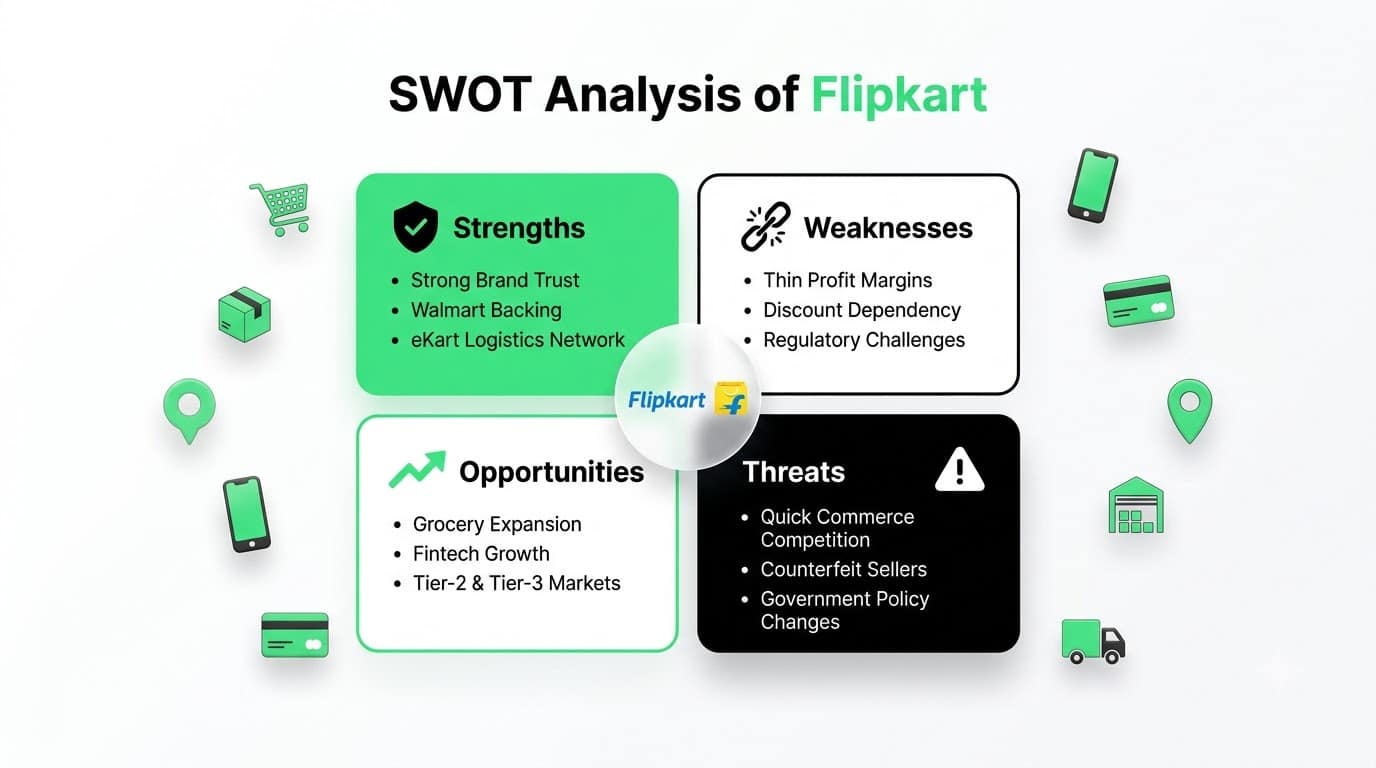
A SWOT Analysis of Flipkart is basically a reality check on the company, split into four honest buckets. Strengths cover what’s actually working: brand trust built over a decade, Walmart’s financial backing, and a supply chain through eKart that’s genuinely hard to copy. Weaknesses get into what’s dragging things down, thin margins on electronics, heavy dependence on discount-driven sales, and ongoing regulatory friction. Opportunities point to where real growth is sitting, things like grocery, financial services, and new users coming online in smaller towns. Threats cover what could actually hurt the business, quick commerce rivals, counterfeit sellers, and shifting government policy.
Strengths in Flipkart
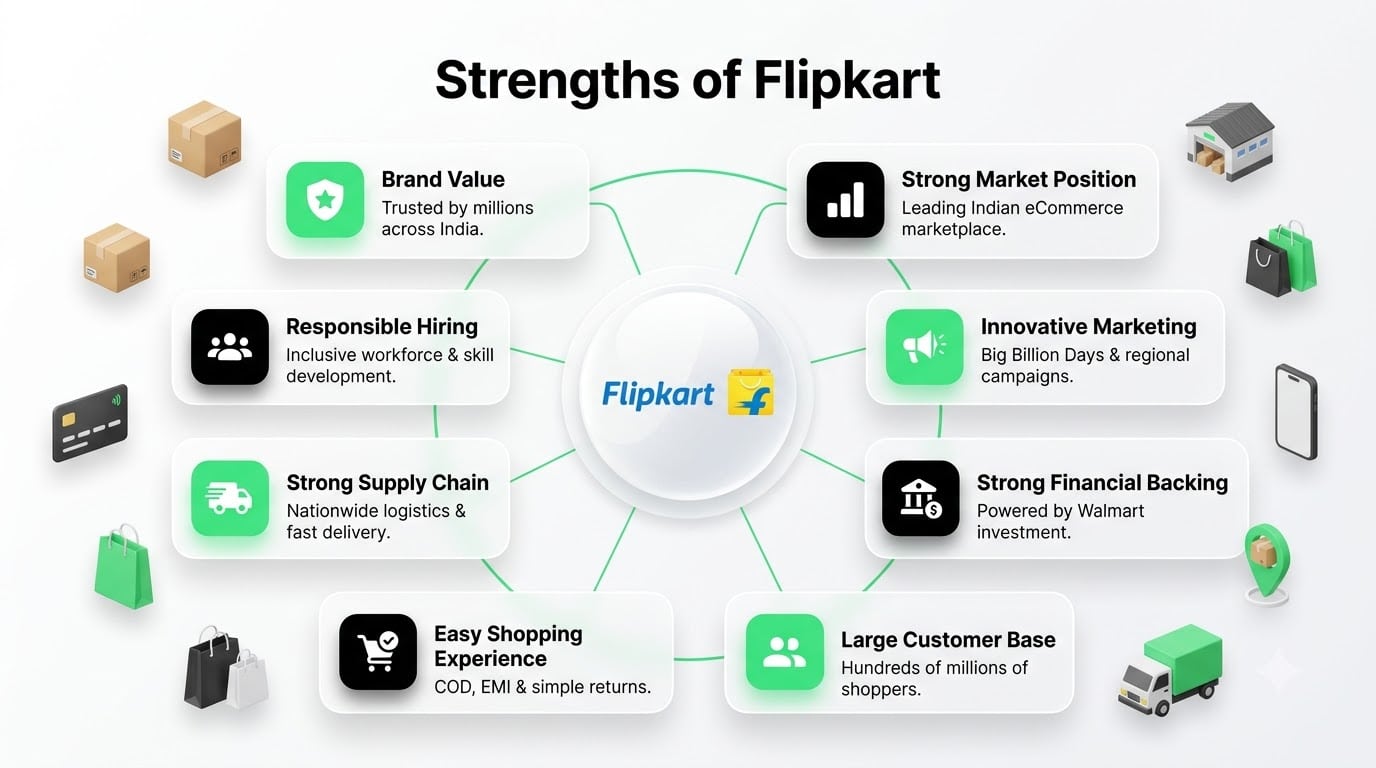
Before getting into the individual points, it helps to step back and ask what actually makes Flipkart strong in the first place. Any honest SWOT Analysis of Flipkart has to start here, because the strengths are what built the company’s ability to survive fifteen years of brutal competition in Indian e-commerce. It’s not one thing. It’s a combination of brand memory, money in the bank from Walmart, and a supply chain that took a decade to build and still isn’t easy for anyone else to copy overnight.
1. Brand Value
Ask someone in a small town in Uttar Pradesh or Madhya Pradesh to name an online shopping app, and there’s a good chance Flipkart comes up before Amazon does. That’s not a small thing. Flipkart spent years building a name that feels local even though it’s owned by an American retail giant. The Big Billion Days sale alone has become a cultural moment, almost like how Diwali shopping used to mean a trip to the local market. People wait for it. That kind of brand recall doesn’t come from an ad budget alone, it comes from years of being the first app people opened when smartphones started getting cheap in India. Flipkart has also managed to keep its Indian identity even after the Walmart acquisition, which honestly surprised a lot of skeptics who assumed the brand would get diluted or Americanized. It didn’t. The logo, the tone of the app, the sale names, all of it still feels homegrown, and that matters more in India than most outsiders realize.
There’s also a generational element to this. Parents who first shopped on Flipkart a decade ago now have kids who grew up seeing the app on the family phone, and that kind of default familiarity is worth more than any single ad campaign. Compare that to how a lot of quick commerce apps are still explaining to first-time users what “ten minute delivery” even means. Flipkart doesn’t have to explain itself. People already know what it is, what it sells, and roughly what to expect when they open it, and that head start is genuinely hard to buy.
2. Strong market position
Flipkart and Amazon India have been fighting for the top spot for years, and depending on which quarter and which report you look at, Flipkart usually holds either the number one or a very close number two position by gross merchandise value. That’s not nothing in a market with over 500 million internet users and counting. Owning Myntra gives Flipkart a serious hold on fashion e-commerce too, which is one of the fastest growing categories online. Add PhonePe into the mix, even though it’s now operationally separate, and you start to see how the broader Flipkart-linked ecosystem touches an enormous chunk of digital transactions in the country. Market position isn’t just about being the biggest, it’s about being unavoidable. If you’re shopping online in India, odds are decent you’ve used a Flipkart product at some point this month, whether that’s the main app, Myntra, or a PhonePe payment.
This kind of position also gives Flipkart negotiating leverage with brands. When a smartphone manufacturer decides where to launch a new model first online, Flipkart’s scale means it’s rarely left out of that conversation, and sometimes it gets exclusive launch rights that competitors don’t. That kind of leverage feeds back into the brand’s strength too, since exclusive product drops keep customers checking the app even outside sale season, which is exactly the kind of habit-forming behavior that’s hard to build once a market matures.
3. Innovative marketing campaigns
Say what you want about Flipkart, but their marketing team knows how to make noise. Big Billion Days ads, the animated mascots, the celebrity tie-ins during festive season, all of it is built to create urgency and a sense that you’re missing out if you don’t check the app today. They’ve also gotten smarter about regional marketing, running campaigns in Tamil, Telugu, Bengali, and Hindi that feel native rather than translated. This matters because a huge chunk of Flipkart’s growth over the last five years has come from tier 2 and tier 3 cities where English-first advertising just doesn’t land the same way. Campaigns built around festivals, cricket season, and local events give Flipkart a cultural foothold that a lot of competitors, especially foreign-first apps, struggle to match. It’s not flashy Silicon Valley marketing. It’s built for how India actually shops.
Cricket deserves a special mention here too. Flipkart has run sponsorships and tie-ins around IPL season for years, betting correctly that a country obsessed with cricket will pay attention to whatever brand shows up during the match breaks. It’s not a subtle strategy, but it works, and the timing usually lines up with either a sale event or a new product launch so the marketing spend does double duty instead of just building generic brand awareness.
4. Strong financial backing
Walmart didn’t buy 77 percent of Flipkart back in 2018 for a small check. That deal, worth about 16 billion dollars, gave Flipkart access to a level of financial muscle that Indian startups almost never get. And it hasn’t stopped there. Flipkart has raised additional funding rounds since, including capital that pushed its valuation past 35 billion dollars in recent years. This kind of backing means Flipkart can afford to lose money on logistics infrastructure for years while it builds out warehouses, delivery hubs, and last-mile networks that smaller competitors simply cannot fund. When quick commerce players like Zepto need to raise emergency rounds just to keep operations running, Flipkart can quietly redirect Walmart-backed capital into whichever category needs it most that quarter. That’s the advantage of not needing to sweat every single funding cycle the way a standalone startup does.
Compare Flipkart’s position to a company like Meesho, which has to raise every round on its own merits and answer tougher questions from investors about burn rate. Flipkart doesn’t operate in a bubble free of that pressure entirely, Walmart still wants returns eventually, but the timeline is longer and the tolerance for short-term losses is wider. That difference alone lets Flipkart make bets on things like grocery delivery or financial services that a leaner, independently funded competitor might not be able to afford to experiment with for as long.
5. Large customer base
Flipkart claims hundreds of millions of registered users, and even accounting for inactive accounts and one-time sale shoppers, the active base is massive. This isn’t just a vanity number. A large user base means better data on shopping patterns, stronger negotiating power with sellers and brands, and enough volume to make even thin margins add up to real revenue. It also creates a flywheel effect. More users mean more sellers want to list on the platform, which means more product variety, which brings in even more users. Flipkart built this base gradually by focusing on affordability first, cheap smartphones, budget electronics, unbranded clothing, before slowly moving up to premium categories once trust was established. That patient approach to growing a customer base the hard way is part of why the loyalty runs deeper than a lot of newer apps that grew fast on discount codes alone.
There’s also a stickiness factor once someone builds up order history, saved addresses, and payment methods on the app. Switching platforms means starting all of that over again, and most people simply don’t bother unless a competitor gives them a genuinely strong reason to, like a much better price or a delivery speed Flipkart can’t match. That inertia works in Flipkart’s favor every single day, quietly, without needing a fresh marketing push to keep those users coming back.
6. Purchasing convenience
Flipkart made online shopping feel safe for people who had never bought anything without touching it first. Cash on delivery was the single biggest trust-builder in Flipkart’s early years, and even now it remains a core option for a huge chunk of orders outside major metros. Easy returns, EMI options through partnerships with banks and NBFCs, and a straightforward app interface all add up to a shopping experience that doesn’t ask much of the user. You don’t need a credit card. You don’t need to fully trust a random seller. Flipkart absorbs a lot of that risk on your behalf. Add features like Flipkart Pay Later, which lets users buy now and settle bills monthly, and you get a platform that removes almost every friction point that used to stop people from shopping online in India. Convenience like this is easy to underrate until you compare it to how clunky online shopping still is on a lot of smaller regional apps.
Voice search and regional language support have quietly become part of this convenience story too. A shopper in a smaller town who’s more comfortable typing in Hindi or Kannada than English can now browse and search Flipkart in their own language, which removes a barrier that used to quietly push a lot of non-English speakers toward WhatsApp-based reselling or local shops instead. Small design choices like this add up to a shopping experience that feels less like navigating a foreign website and more like something built with the actual user in mind.
7. Strong Supply Chain
This is probably Flipkart’s most underrated strength. eKart, Flipkart’s in-house logistics arm, handles deliveries across thousands of pin codes, including plenty of places where courier companies used to refuse to go. Building this network took years and a genuinely large amount of capital, and it’s not something a new entrant can replicate in a couple of funding rounds. Flipkart’s warehouses are spread across the country in a way that lets them promise next-day or two-day delivery in most urban and semi-urban areas. During Big Billion Days, when order volumes spike into the tens of millions within days, this supply chain is what keeps the whole operation from collapsing under its own weight. Competitors have tried to build similar networks, but replicating a decade of warehouse placement, driver relationships, and route optimization isn’t something that happens overnight, even with a lot of money behind you.
eKart’s reach also gives Flipkart a data advantage that’s easy to overlook. Every delivery generates information about which routes are slow, which areas have high return rates, and which pin codes are worth investing more warehouse capacity into. Amazon has its own logistics network in India, no doubt, but Flipkart’s is arguably more tuned to Indian road conditions, traffic patterns, and the reality of navigating addresses that don’t always follow a clean numbering system. That kind of localized know-how doesn’t show up on a balance sheet, but it shows up in delivery times, which is what customers actually notice.
8. Responsible Hiring
Flipkart has made a visible effort in recent years to hire from diverse backgrounds, including women returning to the workforce after career breaks, people with disabilities, and workers from smaller towns who wouldn’t normally get a shot at a corporate job. Their warehouse and delivery hiring practices have also drawn attention for including women delivery agents in a field that used to be almost entirely male. This isn’t just good PR, though it certainly helps with that too. A workforce pulled from a wider talent pool tends to understand a wider range of customers, which matters for a company trying to sell to literally every kind of Indian household. It also builds goodwill with regulators and the public at a time when gig worker treatment across the e-commerce and food delivery industry is under a lot of scrutiny.
Flipkart has also partnered with skilling programs and vocational training initiatives aimed at preparing workers from underserved backgrounds for warehouse and logistics roles, not just entry-level delivery positions. Over time this kind of hiring approach can shape company culture in ways that are hard to quantify but real, a workforce that reflects the country it serves tends to make fewer tone-deaf decisions in product design and customer service, and that shows up in small ways across the whole platform.
Weaknesses in Flipkart
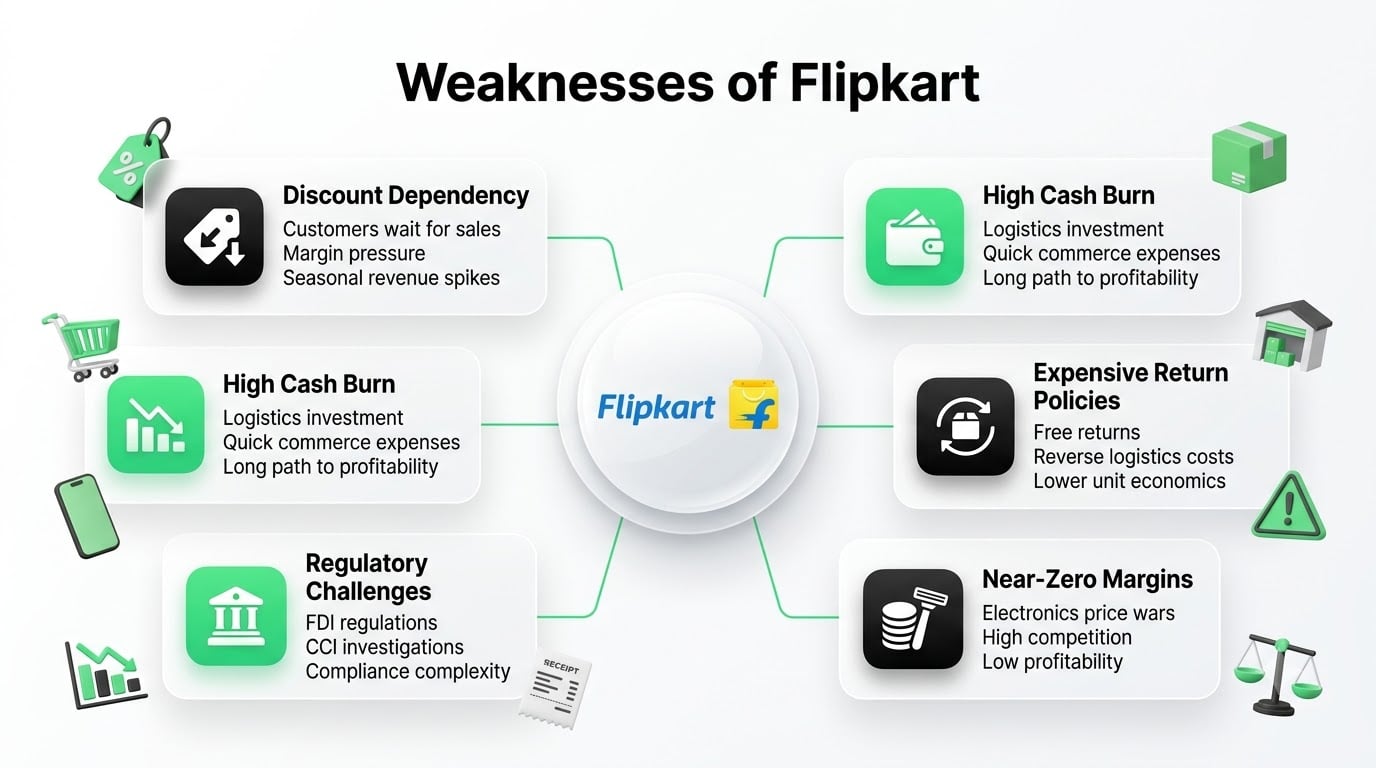
No company gets a free pass, and Flipkart definitely has cracks worth talking about. This section of the SWOT Analysis of Flipkart looks at where the business is genuinely vulnerable, not the small stuff, but the structural issues that show up in earnings calls, seller forums, and regulatory filings year after year. Some of these are baked into the discount-driven model Flipkart built its early growth on, and they’re proving hard to shake off even now that the company is more mature.
1. Heavy Dependence on Discounts
Flipkart trained an entire generation of Indian shoppers to wait for a sale. That worked brilliantly for growth, but it created a monster that’s hard to control now. A huge share of Flipkart’s annual order volume still comes concentrated around Big Billion Days and a handful of other flash sale events. Outside those windows, conversion rates drop noticeably, because customers have learned that prices will fall again soon enough if they just wait. This makes revenue lumpy and unpredictable, and it puts constant pressure on margins because the discounts aren’t optional anymore, they’re expected. Try running a full-price catalog for a month and watch what happens to daily active users. The discount culture Flipkart built to win market share is now something it has to keep feeding just to maintain its position, which isn’t a healthy long-term dynamic for any retail business.
There’s a psychological cost too that’s harder to measure. Once a shopper gets burned buying something a week before a sale and then watches the price drop by 30 percent, they remember. That memory shapes future behavior in a way that’s tough to undo, and Flipkart’s own sale calendar basically trains people to distrust the everyday price shown on the app. Retailers who built loyalty programs around consistent value, rather than periodic discounting, tend not to run into this specific trust problem, but that ship sailed for Flipkart a long time ago.
2. High Cash Burn
Even with Walmart’s backing, Flipkart has historically posted large losses, sometimes running into thousands of crores annually when you add up losses across Flipkart, Myntra, and other group entities before their separate reporting. Quick commerce expansion through Flipkart Minutes has added a fresh layer of cash burn on top of the existing logistics and marketing spend. Dark stores don’t come cheap, and neither does the ten-minute delivery promise that requires inventory sitting idle in hundreds of micro-warehouses across major cities. Investors have gotten more patient with Indian e-commerce over the years, but patience isn’t infinite. At some point the path to sustainable profit has to become clearer than “we’ll figure it out once we have more scale,” and that pressure is only going to increase as competitors like Amazon and Reliance also burn cash trying to win the same customers.
Walmart’s own quarterly filings occasionally give outside observers a window into how the international e-commerce segment, which includes Flipkart, is performing, and the picture is usually one of narrowing losses rather than actual profit. That’s progress, sure, but narrowing losses over several years is a slower story than investors in a hotter market might tolerate. If interest rates stay elevated or if global capital gets more selective about funding growth-stage e-commerce, the pressure on Flipkart to show a faster route to breakeven is only going to build.
3. Double-Edged Sword of Customer Satisfaction
Flipkart’s return policy is generous, arguably too generous in some categories like fashion and electronics. That generosity built trust early on, but it also created a return rate problem that eats into margins constantly. Customers order three sizes of the same shirt knowing they’ll return two, or buy a phone just to test it out before deciding whether to keep it. Flipkart’s own customer satisfaction scores look good on paper, but the operational cost of maintaining that satisfaction, free returns, quick refunds, generous replacement policies, is a real drag on unit economics. It’s a genuine bind. Tighten the return policy and customer trust takes a hit. Keep it loose and margins keep bleeding. Flipkart hasn’t found a clean way out of this trade-off, and honestly, nobody in Indian e-commerce fully has either.
Fashion isn’t the only category where this bites. Electronics returns, especially around Big Billion Days when volumes spike, create a logistical mess of reverse pickups, quality checks, and restocking that eats into the very margins those sale prices were supposed to protect. Some sellers have started quietly building the expected return rate into their pricing on Flipkart, which just means customers who don’t return anything end up subsidizing the ones who treat the platform like a free trial service.
4. Legal and regulatory issues
Flipkart has faced repeated scrutiny from the Competition Commission of India and various trader associations over allegations of deep discounting, preferential treatment for certain sellers, and predatory pricing that smaller offline retailers say pushes them out of business. FDI rules for e-commerce in India are strict about marketplace models not directly controlling inventory, and Flipkart has had to restructure parts of its business over the years to stay compliant. These aren’t minor paperwork issues. A CCI investigation or an adverse court ruling can force operational changes overnight, and the ongoing tension with organizations like the Confederation of All India Traders has kept Flipkart under a level of political and legal pressure that Amazon India shares but that purely domestic-first players like Meesho face less intensely. This is a weakness that isn’t going away soon, because the underlying disagreement about how much power a marketplace should have is still unresolved at a policy level.
Data localization is another slow-moving pressure point. Proposed rules around storing Indian user data within Indian servers, and restrictions on how that data can be used for targeted advertising or seller recommendations, could force Flipkart to rework technical infrastructure that’s currently built around global systems shared with Walmart. None of this is a five-alarm fire on its own, but stacked together, the regulatory environment for large e-commerce platforms in India keeps getting more complicated rather than simpler, and Flipkart has to budget real legal and compliance resources just to keep up.
5. Near-zero margin business models
A lot of Flipkart’s core categories, especially mobile phones and large appliances, run on razor-thin margins because that’s what it takes to stay price competitive. Electronics alone can account for a massive share of Flipkart’s total sales volume, and margins in that category are notoriously thin across the entire industry, not just for Flipkart. This means the company needs enormous scale just to turn a reasonable profit, and any dip in volume during a slow quarter hits the bottom line hard. Categories with better margins, like fashion through Myntra or private label products, help offset this, but electronics remains the volume driver and the margin drag at the same time. It’s a structural tension that’s baked into the Indian e-commerce market overall, where price sensitivity is high and customers will switch apps over a difference of a few hundred rupees.
Private label products were supposed to be part of the fix here, and to some extent they are. Flipkart’s own brands in categories like electronics accessories and home goods carry better margins than reselling a big brand’s inventory. But building private label trust takes years, and customers who came to Flipkart specifically to buy a Samsung or an Apple product at a discount aren’t automatically going to switch to an unfamiliar Flipkart-owned brand just because the margin math works out better for the company.
Opportunities in Flipkart
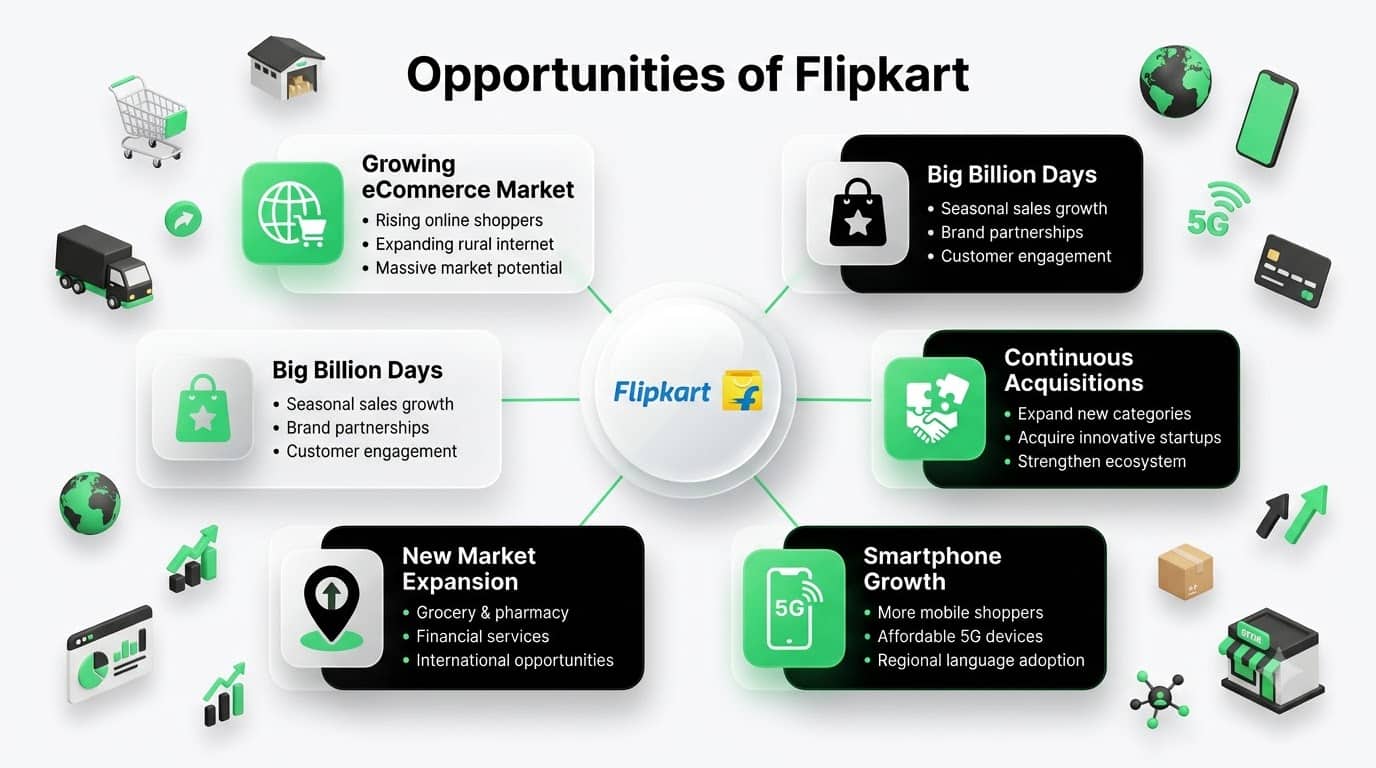
This is where things get interesting. India’s internet economy still has a lot of room to grow, and Flipkart is positioned to catch a good chunk of that growth if it plays its cards right. Any forward-looking SWOT Analysis of Flipkart has to spend real time here, because the opportunities in front of the company are arguably bigger than what it’s already captured in its first fifteen years.
1. Rapidly growing e-commerce market
India’s e-commerce market is still expanding at a pace that most developed markets stopped seeing years ago. Internet penetration keeps climbing, data costs remain among the cheapest in the world, and first-time online shoppers are still coming from tier 3 and tier 4 towns in large numbers every year. Estimates put India’s overall e-commerce market on track to cross well over 200 billion dollars in the coming years, and Flipkart is one of maybe three or four players positioned to capture a meaningful slice of that growth. This isn’t a mature market fighting over scraps. It’s a market where the pie itself keeps getting bigger, which gives Flipkart room to grow revenue even without stealing much share from competitors, though obviously it’s trying to do both at once.
Rural internet growth is probably the most underappreciated part of this story. Telecom operators have kept pushing cheap data deep into districts that had almost no broadband a decade ago, and every new district that gets reliable 4G coverage is a fresh pool of potential shoppers who’ve never bought anything online before. Flipkart’s early bet on affordability and cash on delivery specifically positioned it to win these customers before Amazon or newer entrants even show up in the conversation, and that head start compounds every year the rural internet base keeps expanding.
2. Big Billion Days sale
Say what you want about the discount dependency issue mentioned earlier, but Big Billion Days remains a genuine competitive weapon. It’s become bigger than a sale, it’s a shopping season that brands plan their entire quarterly launches around. Smartphone companies time their India launches to coincide with it. Apparel brands clear old inventory through it. The event generates order volumes that dwarf regular months and gives Flipkart a data goldmine on consumer behavior that feeds back into recommendations and inventory planning for the rest of the year. If Flipkart can find ways to extend some of that Big Billion Days energy into smaller recurring sale events without cannibalizing the big one, there’s real revenue upside sitting there that hasn’t been fully tapped yet.
There’s also an underused opportunity in stretching the Big Billion Days brand into more moments throughout the year without diluting the flagship event. A smaller “mini” sale timed around back-to-school season, or a dedicated appliance-focused sale ahead of summer, could capture demand that currently just waits for the big one. Amazon has experimented with exactly this kind of calendar spreading, and Flipkart doing more of the same, carefully, without training customers to expect discounts every single month, is low-hanging fruit that’s still mostly unclaimed.
3. Continuous Acquisition
Flipkart has a track record of buying its way into categories rather than building everything from scratch, and that strategy still has room to run. Myntra gave it fashion. Cleartrip gave it a foothold in travel booking. Various smaller acquisitions over the years have plugged gaps in logistics tech, supply chain software, and hyperlocal delivery. With Walmart’s balance sheet behind it, Flipkart can keep hunting for smaller, capital-starved startups in categories like quick commerce, financial services, or even health tech and folding them into the broader ecosystem. This is often faster and cheaper than building in-house, especially in categories where a scrappy startup has already solved the hard early problems and just needs distribution, which Flipkart has in spades.
The smartest acquisitions tend to be the boring ones nobody notices at first, a logistics software company that shaves a few minutes off delivery routing, or a small fintech startup that improves fraud detection on Flipkart Pay Later. These aren’t headline-grabbing deals like the Myntra purchase, but they compound quietly over time and often deliver better returns per rupee spent than a flashy acquisition aimed at grabbing press coverage. Flipkart’s acquisition team has gotten reasonably good at spotting these smaller, less glamorous opportunities over the past several years.
4. Expansion into new markets
Domestically there’s still runway in categories Flipkart hasn’t fully cracked, like grocery, where JioMart and Blinkit currently have an edge, or premium and luxury goods, where Amazon and dedicated platforms like Tata CLiQ Luxury have more traction. Internationally, Flipkart hasn’t pushed hard beyond India, and there’s an open question about whether the playbook that worked here could translate to other price-sensitive, mobile-first markets in South Asia or Southeast Asia. Walmart’s global presence could theoretically support that kind of expansion if the company decided it was worth the investment. Even without going abroad, just deepening penetration in categories like grocery and pharmacy within India represents a genuinely large opportunity that’s still mostly unclaimed.
Financial services is another market worth watching closely. Flipkart Pay Later already gives the company a foothold in consumer lending, and there’s an obvious path toward expanding into insurance, small business loans for its own sellers, and other fintech products that use the platform’s existing customer data to underwrite risk more accurately than a traditional bank could. This is a genuinely large market in India, and Flipkart already has the distribution and trust needed to make a serious push if it decides the regulatory complexity is worth taking on.
5. Increasing penetration of smartphone
Cheap smartphones and falling data prices completely changed who shops online in India over the last decade, and that trend hasn’t finished playing out. Rural India and smaller towns are still adding first-time internet users every single quarter, and a huge share of them start their online shopping journey on Flipkart because of the brand recognition built over years. As 4G gives way to wider 5G coverage and phone prices keep dropping, the pool of potential Flipkart customers keeps expanding on its own, almost independent of anything the company actively does. This is one of those tailwinds that just keeps blowing in Flipkart’s favor as long as it keeps its app lightweight, affordable to use on cheap data plans, and accessible in regional languages, which it has been steadily improving over the years.
Cheaper 5G-enabled devices are also starting to change what people expect from a shopping app, faster load times, richer video content for product listings, and smoother checkout experiences that don’t stutter on a mid-range phone. Flipkart’s engineering team has to keep optimizing for a device landscape that spans everything from a sub-10,000 rupee smartphone to a flagship iPhone, and getting that balance right keeps the app usable for the exact customers driving this growth in the first place.
Threats in Flipkart
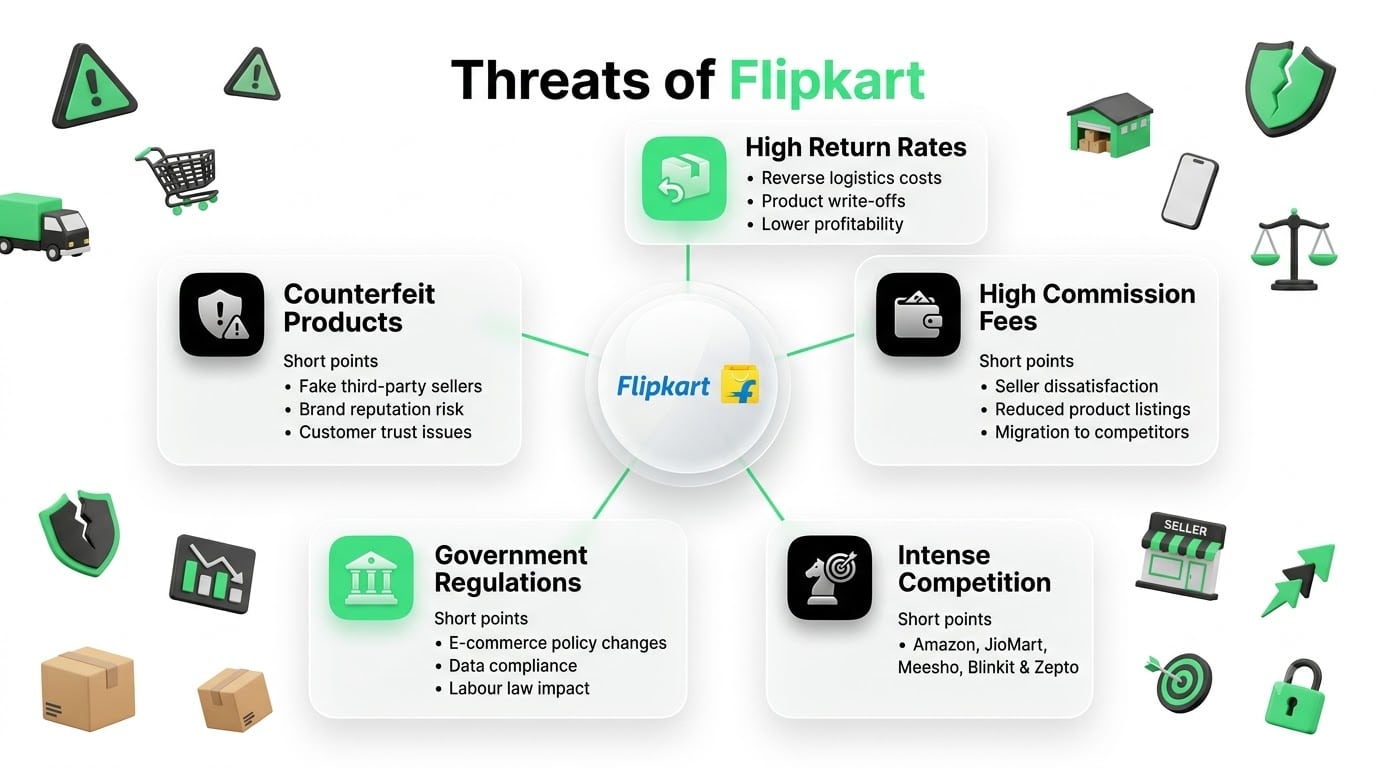
Here’s the part that keeps Flipkart’s leadership up at night, probably. The threats section of this SWOT Analysis of Flipkart isn’t about hypothetical risks, these are things actively chipping away at the business right now, some of them faster than Flipkart’s management would probably like to admit.
1. Increase in counterfeit product
Fake products slipping through third-party sellers remain a persistent headache. Despite Flipkart’s verification processes and seller vetting, counterfeit electronics accessories, fake branded clothing, and knockoff cosmetics still show up often enough that it’s a regular topic on Indian consumer forums and social media complaints. Every viral post about someone receiving a fake product damages trust in the platform a little more, even if the actual percentage of counterfeit orders is small relative to total volume. Brands have also gotten more aggressive about legal action against marketplaces that host counterfeit listings of their products, which adds legal risk on top of the reputational damage. This is a problem that scales with the platform itself, more sellers and more listings inevitably means more bad actors slipping through the cracks.
Third-party seller verification is genuinely hard to do at scale. With hundreds of thousands of sellers listing products across countless categories, even a small percentage slipping through as counterfeit adds up to a meaningful number of unhappy customers every month. Flipkart has invested in AI-based listing scans and stricter seller onboarding checks, but counterfeiters adapt just as fast, tweaking product photos and descriptions to slip past automated filters. It’s an arms race that never fully ends, and every high-profile counterfeit story that goes viral chips away a little more at the trust Flipkart worked years to build.
2. High return rates
The generous return policy mentioned earlier as a weakness doubles as a genuine threat to profitability. Fashion categories in particular can see return rates climb into double-digit percentages, sometimes well above 20 percent depending on the sub-category. Every returned item costs money to process, restock, or in some cases simply write off if it’s damaged or can’t be resold. As Flipkart pushes further into fashion through Myntra and its own private labels, this return rate problem doesn’t shrink, it grows alongside the category. Quick commerce delivery for fashion, which some competitors are experimenting with, could make this even worse if impulse purchases lead to even higher return volumes than regular delivery windows already produce.
Reverse logistics, the process of picking up a returned item, checking it, and getting it back into sellable condition or writing it off, is quietly one of the most expensive parts of running an e-commerce operation at Flipkart’s scale. Every returned pair of jeans or pair of shoes needs a delivery agent, fuel, warehouse handling, and often a quality inspector, and none of that generates a single rupee of revenue. As competitors experiment with stricter return windows or smaller return fees to discourage casual returning, Flipkart faces pressure to do the same without damaging the customer trust that generous returns helped build in the first place.
3. High commission fees
Sellers on Flipkart have complained for years about commission structures that eat heavily into their margins, sometimes ranging anywhere from 5 percent to over 25 percent depending on the category, on top of additional fees for logistics, advertising placement, and account management services. Smaller sellers especially feel squeezed, and some have started diversifying onto platforms like Meesho, which built its early reputation partly on lower fees for small and medium sellers. If Flipkart keeps raising fees to improve its own margins, it risks pushing its most price-sensitive sellers toward competitors, which could thin out product variety on the platform over time, especially in unbranded and small-manufacturer categories that gave Flipkart a lot of its early catalog depth.
Seller forums and Facebook groups dedicated to Flipkart marketplace sellers regularly feature long threads comparing fee structures across platforms, and Meesho’s zero-commission model for certain categories comes up constantly as a point of comparison. Flipkart obviously provides more in return, better logistics, a larger customer base, more sophisticated advertising tools, but sellers running thin-margin businesses don’t always see it that way when they’re staring at a settlement report showing how much got deducted before the money hit their account. That friction, repeated across enough sellers, eventually shapes which platform gets a seller’s best inventory and fastest restocking priority.
4. Government regulations
India’s e-commerce policy landscape keeps shifting, and not always in directions that favor large marketplaces. Draft e-commerce rules have periodically proposed restrictions on flash sales, deeper scrutiny of algorithmic pricing, and stricter data localization requirements. Any of these, if enacted in a strict form, could force Flipkart to change core parts of how it operates, potentially raising costs or slowing down the exact discount-driven growth engine that built the company. The relationship between large e-commerce platforms and India’s massive offline retail lobby remains politically sensitive, and government policy tends to respond to that pressure over time. Flipkart has to keep one eye on Delhi’s policy corridors just as much as it watches Amazon’s next move.
Labor regulation is a related area worth watching. Gig worker classification for delivery agents, questions about minimum earnings guarantees, and social security benefits for platform workers have become active policy conversations in India, following similar debates that played out in Europe and the United States years earlier. If Indian regulators move toward classifying delivery workers with stronger employment protections, the cost structure for eKart’s massive delivery workforce could shift meaningfully, and that’s the kind of regulatory change that doesn’t just affect Flipkart, it affects every logistics-heavy platform operating in the country at the same time.
5. Intense competition from websites
Amazon India isn’t going anywhere, and it fights Flipkart on nearly every front, from Prime Day sales timed to compete directly with Big Billion Days, to aggressive pricing on electronics and daily essentials. Reliance’s JioMart brings deep pockets and an existing retail footprint across thousands of physical stores that Flipkart can’t easily replicate. Meesho has carved out a genuinely large user base among price-sensitive shoppers with a social commerce model that undercuts traditional marketplace fees. And then there’s the entire quick commerce category, Blinkit, Zepto, Instamart, which has redefined what speed means for online shopping and forced Flipkart to build Flipkart Minutes just to stay relevant in that conversation. Competing on this many fronts at once spreads resources thin and makes it harder for Flipkart to dominate any single category the way it once dominated general e-commerce in its early years.
Category-specific apps add another layer of pressure that’s easy to underestimate. Nykaa dominates beauty and cosmetics with a level of category expertise that a general marketplace struggles to match. Lenskart owns eyewear. BookMyShow handles entertainment ticketing in a way Flipkart never tried to compete with directly. Every one of these specialists chips away a slice of category-specific spend that used to flow through general marketplaces, and Flipkart has to keep proving that shopping everything under one app is still worth it compared to using five specialized apps each built specifically around one category’s needs.
Conclusion
Put all of this together and Flipkart in 2026 looks like a company standing on a genuinely strong foundation while facing real pressure from every direction at once. The brand strength, the supply chain, the Walmart-backed capital, none of that disappears overnight, and it gives Flipkart a real cushion that a lot of smaller competitors simply don’t have. But the weaknesses aren’t cosmetic either. Discount dependency, thin margins, and ongoing regulatory friction are structural issues baked into how the business grew up, not small operational glitches that a new feature update can fix.
The opportunities in front of Flipkart are honestly larger than what most people give the company credit for. India’s internet economy still has years of growth ahead, and Flipkart’s brand recognition puts it in a strong position to capture a fair share of new users entering the market for the first time. The threats though are moving fast, quick commerce especially has changed customer expectations in a way that Flipkart is still catching up to rather than leading. Whether Flipkart holds its position over the next five years probably comes down to how well it manages that tension between defending its core marketplace business and chasing the newer, faster-moving parts of Indian e-commerce that customers increasingly expect. It’s not a company in crisis. But it’s not coasting either, and 2026 is shaping up to be a year where the choices Flipkart’s leadership makes will matter more than usual.
If you’re studying this as a business case or just trying to understand India’s e-commerce landscape, the lesson from Flipkart isn’t really about any single quarter’s numbers. It’s about how a company built on a discount-first model tries to grow up without losing the thing that made it big in the first place. Some companies manage that transition well, Amazon did it globally over two decades. Others stumble because the habits that built early growth become genuinely hard to unwind once customers and sellers both depend on them. Which path Flipkart ends up on is still being written, and that’s exactly what makes watching this company over the next few years worth paying attention to.
Frequently Asked Questions
1. What is the biggest strength of Flipkart in 2026?
Flipkart’s biggest strength is probably its combination of brand trust and logistics infrastructure through eKart. Years of reliable delivery across thousands of pin codes, even in smaller towns, built a level of trust that’s genuinely hard for newer competitors to replicate quickly, regardless of how much funding they raise.
2. Is Flipkart still losing money in 2026?
Flipkart has historically operated at a loss for years while prioritizing growth and market share over immediate profitability. While specific yearly figures shift, the broader pattern of heavy spending on logistics, quick commerce expansion through Flipkart Minutes, and marketing during sale events continues to weigh on near-term profitability even as revenue keeps growing.
3. Who owns Flipkart now?
Walmart owns a majority stake in Flipkart, having acquired roughly 77 percent of the company in 2018 for around 16 billion dollars. Founders and early investors retain smaller stakes, and Flipkart has continued raising additional funding rounds since the acquisition, which has adjusted ownership percentages over time.
4. How does Flipkart compete with quick commerce apps like Blinkit and Zepto?
Flipkart launched Flipkart Minutes to compete directly in the ten-minute delivery space, building out dark stores in major cities. It’s playing catch-up rather than leading in this category, since Blinkit, Zepto, and Swiggy Instamart established themselves first and already have strong brand recognition specifically for speed.
5. What is Flipkart’s Big Billion Days and why does it matter?
Big Billion Days is Flipkart’s flagship annual sale event, typically held around the festive season in India. It generates a massive share of the company’s annual order volume within a short window and has become a cultural shopping moment that brands actively plan product launches and inventory clearance around.
6. What are the main weaknesses in Flipkart’s business model?
The core weaknesses include heavy reliance on discount-driven sales to maintain volume, thin margins in high-volume categories like electronics, high cash burn from logistics and quick commerce expansion, and ongoing regulatory pressure from Indian competition authorities and offline trader associations over pricing practices.
7. Does Flipkart face legal or regulatory challenges in India?
Yes, Flipkart has faced repeated scrutiny from the Competition Commission of India over allegations of deep discounting and preferential seller treatment, along with pressure from trader associations like CAIT. India’s foreign direct investment rules for e-commerce also require ongoing compliance around marketplace versus inventory-based business models.
8. How big is Flipkart’s customer base?
Flipkart reports hundreds of millions of registered users across its platforms, including Flipkart, Myntra, and Cleartrip. The active user base, while smaller than the total registered number, still represents one of the largest e-commerce audiences in India, spanning both metro cities and smaller tier 2 and tier 3 towns.
9. What is Flipkart’s biggest threat going into the next few years?
Intense competition across multiple fronts at once is probably the biggest threat. Amazon India competes on price and scale, Reliance JioMart brings an offline retail advantage, Meesho undercuts on seller fees, and quick commerce apps have changed delivery speed expectations faster than Flipkart has been able to fully adapt to.
10. How does Flipkart make money if margins are so thin?
Flipkart earns through a mix of commission fees from third-party sellers, advertising and sponsored listing revenue, logistics fees for using eKart, and higher-margin categories like fashion through Myntra and private label products. Scale helps offset thin margins in categories like electronics, where volume matters more than per-unit profit.
11. What opportunities does Flipkart have for future growth?
Growth opportunities include deepening penetration in categories like grocery and pharmacy, expanding financial services offerings, continuing its acquisition strategy to enter new verticals quickly, and capturing new first-time internet users in smaller towns as smartphone and data access keep expanding across India.
12. Is Flipkart still bigger than Amazon in India?
Depending on the specific metric and reporting period, Flipkart and Amazon India frequently trade places for the top spot by gross merchandise value in Indian e-commerce. Flipkart tends to hold a stronger position in categories like fashion through Myntra, while Amazon often leads in certain electronics and Prime membership-driven categories.
13. What role does Myntra play in Flipkart’s overall strategy?
Myntra gives Flipkart a strong hold on fashion e-commerce, a category with generally better margins than electronics. It operates somewhat independently in terms of branding but benefits from Flipkart’s broader logistics network and customer base, making it a key part of how Flipkart diversifies beyond low-margin categories.
14. What is Flipkart Minutes and how does it fit into the SWOT picture?
Flipkart Minutes is the company’s quick commerce arm, built to compete with Blinkit, Zepto, and Swiggy Instamart on ten-minute grocery and essentials delivery. It represents both an opportunity to capture a fast-growing category and a threat-driven necessity, since Flipkart risked losing relevance in daily essentials shopping without a fast delivery option of its own.
15. How does counterfeit product risk affect Flipkart’s brand?
Counterfeit products slipping through third-party sellers damage customer trust every time a fake item goes viral on social media or gets flagged in a review. Even though Flipkart has verification systems in place, the sheer scale of listings across hundreds of thousands of sellers makes it genuinely difficult to catch every single bad actor before a customer receives a fake product.