Open any Indian shopping app in the last week of September and you’ll see the same thing everywhere. Flipkart’s blue and yellow colours splashed across banners, a countdown clock ticking down, and some Bollywood star telling you to grab a deal before it’s gone. That’s not an accident. That’s years of work, testing, and rework going into one brand that figured out how to make shopping feel like an event.
Most people think Flipkart’s success is just about low prices. Honestly, that’s a lazy read of what’s actually happening. Amazon has deep pockets too. Meesho undercuts on price constantly. Yet Flipkart still owns a massive share of India’s online shopping mind space, especially during festive season. That’s not price. That’s marketing, done with a level of cultural fluency that a lot of global brands entering India never manage to pull off.
This piece breaks down exactly how Flipkart built that position, what’s working right now, what’s clearly not landing, and what a brand in a similar spot could learn from watching Flipkart closely. We’re not going to talk in vague consultant language about “leveraging synergies.” We’re going to look at actual campaigns, actual numbers, actual choices Flipkart made and why some of them paid off big while others quietly got dropped.
What You Will Learn in This Guide
- How Flipkart built its brand from a small bookstore website into India’s second-biggest e-commerce name
- The actual buyer personas Flipkart targets and what drives their buying decisions
- Every major marketing channel Flipkart uses and why each one exists in the mix
- The content, SEO, influencer, and performance marketing tactics behind Flipkart’s biggest wins
- What Big Billion Days really teaches about running a sale that people actually look forward to
- Where Flipkart’s marketing has stumbled and why those mistakes matter
- Practical takeaways any e-commerce brand, big or small, can actually use
About Flipkart

Flipkart started in 2007, founded by Sachin Bansal and Binny Bansal, two guys who used to work at Amazon and figured India needed its own version of online shopping built for Indian problems. It began as an online bookstore, nothing fancier than that. Books were an easy category to start with because they don’t need trial, sizing, or much customer hand-holding. From there it kept expanding, adding electronics, fashion, home goods, groceries, basically everything a typical Indian household buys in a year.
By 2018, Walmart bought a majority stake in Flipkart for around 16 billion dollars, which at the time was one of the biggest ecommerce acquisitions anywhere in the world, not just in India. That deal gave Flipkart the capital muscle to fight Amazon head-on without blinking every quarter. Today Flipkart runs multiple businesses under one roof, the core marketplace, Flipkart Fashion, Myntra (which it owns), Cleartrip for travel, and PhonePe was part of the family too before it was spun off separately.
What makes Flipkart interesting from a marketing lens isn’t the size of the business. It’s how deeply Indian the brand feels despite having Walmart’s money behind it. That’s a hard balance to strike, and Flipkart’s marketing team clearly obsesses over keeping that local, relatable tone even as the company has scaled into a multi-billion dollar operation.
Marketing Goals & Objectives
Flipkart isn’t chasing a single goal. Depending on the season and the business unit, the priorities shift, but a few core objectives run through everything the brand does. First, there’s the obvious one, driving transactions and gross merchandise value, especially during big sale events where a huge chunk of yearly revenue gets locked in over just a few days. Second, there’s brand recall. Flipkart wants to be the first name that pops into someone’s head the moment they think about buying something online, before Amazon, before Meesho, before anyone else.
Third, and this one doesn’t get talked about enough, Flipkart is constantly working to build trust in tier 2 and tier 3 cities where online shopping still feels a bit risky to a lot of first-time buyers. Getting someone in a small town in Bihar or Odisha to trust that a product will arrive as shown, and that returns actually work if something’s wrong, that’s a genuine marketing objective, not just a logistics problem. Fourth, Flipkart wants seller and merchant growth too, since a big part of its business model depends on third-party sellers using the platform and its ad tools to reach buyers.
Buyers Persona:
Flipkart doesn’t market to one type of person. It’s segmenting hard, and it should, because urban Bangalore techies and small-town first-time online shoppers want completely different things from the same platform. Broadly, the personas fall into a few buckets: the value-conscious family shopper who waits for sales, the young urban professional buying gadgets and fashion regularly, and the first-time internet shopper in a smaller town who’s cautious but curious. Each of these gets different messaging, different ad creative, and sometimes different app experiences entirely, down to language and interface simplicity.
Motivation
For most Flipkart buyers, the core motivation is simple: get a good deal without the hassle of stepping into a crowded market or mall. Price matters a lot, sure, but convenience matters just as much, maybe more for working professionals who don’t have time to go store-hopping. There’s also an emotional layer here that Flipkart plays on constantly. The idea of surprising your family with a new TV during Diwali, or finally affording that phone you’ve wanted for months because of a flash sale, that emotional payoff is baked directly into the ad campaigns, not left as an afterthought.
Interests & Hobbies
Flipkart’s core buyer base tends to skew toward people who are into gadgets, fashion trends, home improvement, and increasingly, fitness and wellness products. A lot of them follow tech YouTubers to decide which phone to buy, follow fashion influencers on Instagram for style cues, and are active on WhatsApp groups where deal links get shared like currency. Understanding this, Flipkart doesn’t just advertise on its own app, it plants itself right inside these interest communities through influencer tie-ups and content partnerships.
Pain Points
The biggest pain point Flipkart’s marketing has to solve for is trust, plain and simple. Will the product match the photo? Will it arrive on time? Will returns actually be smooth if something goes wrong? Beyond trust, there’s price sensitivity, a huge chunk of Indian buyers are actively comparing prices across Flipkart, Amazon, and local stores before hitting buy. And then there’s decision fatigue, so many options, so many similar products, that shoppers often need extra nudges like reviews, ratings, or a trusted face on screen telling them “yeah, this one’s good” before they commit.
Social Media Presence
Flipkart runs an active presence across Instagram, YouTube, X (formerly Twitter), and Facebook, but the tone shifts depending on the platform. Instagram leans heavily visual and trend-driven, tapping reels and memes around festive shopping. YouTube gets longer-format content, unboxings, ad films, and influencer collaborations. X is mostly used for quick engagement, replying to customer queries, and jumping on trending conversations with witty, on-brand humor. This isn’t posting for the sake of posting, every platform serves a distinct purpose in the funnel.
Marketing Channels Used by Flipkart
Flipkart doesn’t rely on one or two channels and call it a day. It spreads its marketing muscle across a genuinely wide mix, and the reason is straightforward: different segments of India consume media completely differently. Someone in Mumbai scrolling Instagram Reels is a different animal from someone in a small town in Uttar Pradesh watching regional television during a cricket match. Television still matters a lot in India, especially during big cricket tournaments and festive seasons, so Flipkart runs TV commercials heavily around Big Billion Days and Diwali.
Digital display and video ads run across Google, YouTube, and programmatic ad networks, targeting people based on browsing behavior and past purchase intent. Social media, as covered above, handles brand engagement and organic buzz. Influencer marketing brings in both macro celebrities for reach and micro-influencers for niche trust. SEO and content marketing quietly drive a huge chunk of non-branded organic traffic, people searching “best phone under 20000” and landing straight on a Flipkart buying guide. And then there’s out-of-home advertising, which Flipkart has gotten surprisingly creative with, including a massive crop-circle style land art installation near airports in Bengaluru and Kanpur ahead of a recent Big Billion Days, designed to be seen by air travellers as they flew in and out. That kind of stunt isn’t about direct conversions, it’s about making people talk, and it worked, because here we are still talking about it.
Marketing Strategy For Flipkart
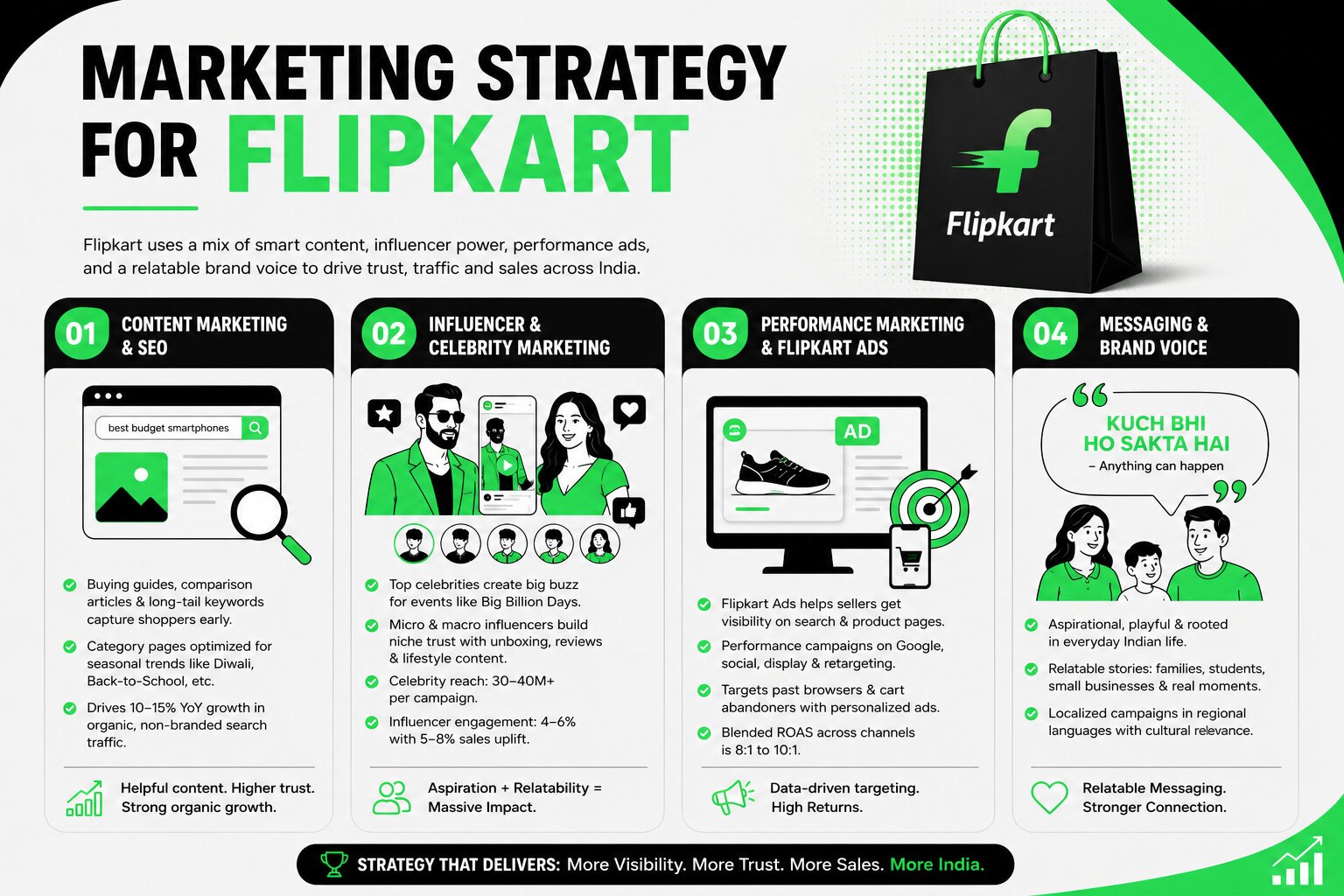
Now let’s get into the actual mechanics. What does Flipkart actually do, tactic by tactic, to turn all this channel presence and audience understanding into real sales and brand loyalty? This is where things get interesting because Flipkart’s approach isn’t one big master plan, it’s a bunch of interlocking tactics that reinforce each other.
1. Content Marketing & SEO
Flipkart puts real effort into content that doesn’t scream “buy now” at every sentence. Buying guides, comparison articles, category pages built around long-tail search terms like “best budget smartphones under 15000” or “top rated washing machines for small families,” these pages exist specifically to catch people early in their research phase, before they’ve even decided what to buy, let alone where. This is a smart move because it reduces dependency on paid ads over time. A focus on long-tail keywords and detailed buying guides has reportedly helped drive year-over-year growth in organic, non-branded search traffic somewhere in the 10 to 15 percent range, which is a solid number for a category this competitive.
Beyond keyword-driven pages, Flipkart also invests in category landing pages optimized for seasonal search spikes, like Diwali gift guides or back-to-school shopping lists. These pages aren’t static either, they get refreshed constantly with new deals, new copy, and updated product recommendations based on what’s actually trending. The SEO team clearly works hand in hand with the merchandising team here, because timing these pages to go live right as search interest spikes takes coordination most brands don’t bother with.
What makes this content strategy work is that it doesn’t feel like an ad. It reads like a helpful guide written by someone who actually knows phones or appliances, not a sales page dressed up as content. That’s a subtle distinction but it matters a lot for trust, especially with the cautious, price-sensitive buyer we talked about earlier.
2. Influencer & Celebrity Marketing
This is probably where Flipkart shines brightest, and honestly, it’s not close. For major events like Big Billion Days, Flipkart pulls in top-tier Bollywood names, think Ranbir Kapoor, Alia Bhatt, Amitabh Bachchan, alongside popular comedians and content creators like Anubhav Singh Bassi, to make the campaign feel like a cultural moment rather than just another sale. These aren’t quiet endorsements either, they’re loud, funny, story-driven ad films that get shared organically because people actually enjoy watching them, not just tolerate them.
Below that celebrity layer, Flipkart runs a much broader network of micro and macro influencers across YouTube and Instagram. These are the tech reviewers doing unboxing videos, the fashion creators styling outfits bought straight off the app, the home decor accounts showing off furniture hauls. This layer matters because it builds something celebrities can’t, niche trust. When a mid-sized tech YouTuber with 200,000 subscribers says a phone’s camera is genuinely good, that carries a different kind of weight than a film star holding up a box on TV.
The blend works because it covers both ends of the psychology of buying. Celebrities create aspiration and buzz at scale, sometimes reaching a cumulative audience of 30 to 40 million per major campaign. Micro-influencers create relatability and product-specific trust, with engagement rates in the 4 to 6 percent range on their promoted content, and this has translated into sales uplifts of roughly 5 to 8 percent in the categories they push. Two very different jobs, done by two very different types of creators, both under the same campaign umbrella.
3. Performance Marketing & Flipkart Ads
Here’s the part that doesn’t get the glamour but keeps the whole machine running financially. Flipkart runs its own ad platform, Flipkart Ads, which sellers on the marketplace use to get their products in front of shoppers actively searching or browsing similar items. Think of it like Amazon’s sponsored product listings, sellers bid to appear higher in search results or on product pages, and Flipkart takes a cut while giving smaller brands a shot at visibility they’d never get organically against bigger competitors.
Beyond the seller side, Flipkart runs its own performance marketing across Google Ads, programmatic display networks, and social platforms, targeting people based on past browsing and cart abandonment. If you’ve ever added something to your Flipkart cart and then seen an ad for that exact product follow you around the internet for the next three days, that’s this machinery at work, and yeah, it’s a little annoying, but it works because it does convert.
The blended return on ad spend Flipkart aims for across its multi-channel performance push typically sits somewhere between 8:1 and 10:1, which is a genuinely strong number in a market as price-competitive as Indian e-commerce. Getting that kind of return requires constant testing, tweaking bid strategies, refreshing creative, pulling underperforming campaigns fast, this isn’t set-it-and-forget-it advertising, it’s active, hands-on management every single day.
4. Messaging & Brand Voice
Flipkart’s brand voice sits in a very specific sweet spot: aspirational but never distant, playful but never careless with trust. The tagline used in a recent Big Billion Days push, “Kuch Bhi Ho Sakta Hai,” roughly translates to “anything can happen,” and that phrase captures exactly what Flipkart’s messaging tries to do, make shopping feel like a bit of magic rather than a transaction. Pratik Shetty, who heads growth and marketing at Flipkart, has talked about wanting Big Billion Days to feel like it creates genuinely surprising moments for people across the country, and that ambition shows up in how the campaigns get written and shot.
The messaging also leans hard into everyday Indian family life. Ads rarely show luxury or excess, instead they show relatable scenes, a mother finally getting the mixer grinder she wanted, a college student affording a laptop for online classes, a small business owner scaling up thanks to easy inventory tools. This isn’t accidental. It’s a deliberate choice to keep the brand feeling like it belongs to regular households, not just urban elites with disposable income, and that choice is exactly why Flipkart’s reach extends so deep into smaller towns where a lot of competitors still struggle to build genuine connection.
Language localization plays into this too. Flipkart doesn’t just translate English ads into Hindi or Tamil, it actually rewrites campaigns with regional cultural references, festivals, and idioms that hit differently in each market. That kind of localization takes real budget and real patience, and it’s one of the clearer signs that Flipkart treats India as dozens of distinct markets rather than one homogenous customer base.
Results & Impact
So does all this actually move the needle? Yeah, pretty clearly. Big Billion Days alone has grown into one of the most talked-about shopping events in the country every year, generating massive spikes in app downloads, new user sign-ups, and gross merchandise value within just a handful of days. Sellers who plan around the event properly often report growth multiples of three to five times their usual sales volume during that window, a number that’s hard to ignore if you’re running any kind of online store in India.
The influencer and celebrity blend has clearly paid off in brand recall too. Ask almost anyone in urban or semi-urban India what comes to mind with Big Billion Days, and most will immediately reference the ad films or the celebrity faces from that year’s campaign, which is exactly the kind of top-of-mind association marketers chase for years without ever quite landing. On the SEO and content side, organic non-branded traffic growth in the 10 to 15 percent range year over year isn’t flashy, but it compounds. Every year that traffic base grows, Flipkart spends relatively less to acquire the same volume of new visitors, which is a genuinely efficient outcome most brands never achieve.
The performance marketing numbers back this up financially. An 8:1 to 10:1 blended ROAS means Flipkart isn’t just buying visibility, it’s buying visibility that pays for itself multiple times over. Combine that with the seller ecosystem growth from Flipkart Ads, and you get a flywheel where more sellers join because ads work, more ads mean more product variety and competitive pricing, and more variety and pricing draws in more buyers who then generate more ad-worthy purchase behavior. That loop is honestly the quiet engine behind a lot of Flipkart’s marketing success, it’s not one campaign, it’s the compounding effect of dozens of tactics reinforcing each other over years.
What Worked & Why?
Let’s get specific about what’s actually landed well, because vague praise doesn’t teach anyone anything. First, the celebrity plus micro-influencer blend worked because it solved two different problems at once, reach and trust, without either one cannibalizing the other. Most brands pick one lane and stay there. Flipkart ran both simultaneously and let each do its job.
Second, the localization strategy worked because India genuinely isn’t one market. A campaign that lands in Mumbai can fall completely flat in a small town in Odisha if the language, cultural references, or even the visual style feels foreign. Flipkart’s willingness to actually rewrite, not just translate, campaigns for different regions gave it an edge competitors with more generic, one-size-fits-all messaging simply didn’t have.
Third, the SEO and content investment worked because it played the long game while most competitors chased short-term paid traffic. Building buying guides and comparison content takes patience, the payoff doesn’t show up in a quarter, it shows up over years as compounding organic traffic. That patience paid off with a meaningfully lower cost of acquisition over time.
Fourth, the out-of-home stunt marketing, like the aerial crop-circle installation, worked because it generated free media coverage and social conversation that no amount of paid advertising could buy directly. People talked about it, journalists covered it, and it reinforced the “anything can happen” brand message in a way that felt genuinely surprising rather than gimmicky.
What Didn’t Work & Why?
Now for the honest part, because not everything Flipkart has tried has landed cleanly. The heavy reliance on discount-driven messaging during major sales has, over time, trained a chunk of its buyer base to simply wait for sale windows rather than buy at regular prices. That’s a double-edged sword. It drives incredible spikes during Big Billion Days, sure, but it can also suppress regular-season demand, since buyers know a bigger discount is probably just weeks away if they hold off.
There’s also been criticism, echoed across various seller communities, about the pressure smaller sellers face to participate in deep-discount events just to stay visible on the platform, sometimes cutting into already thin margins. Marketing built around massive percentage-off numbers looks great from the buyer’s side, but if it squeezes seller profitability too hard, that’s a long-term risk to platform health that pure marketing wins can mask in the short term.
Another rough patch has been counterfeit and quality control concerns that occasionally surface around third-party sellers, which directly undercuts the trust-building messaging Flipkart invests so heavily in elsewhere. No amount of warm, family-focused ad storytelling fixes a customer’s experience if a product arrives damaged or doesn’t match the listing, and these incidents, even if relatively rare, get amplified fast on social media, sometimes undoing weeks of brand goodwill in a single viral complaint thread.
Finally, some of the celebrity-heavy campaigns, while great for buzz, have occasionally been called out for feeling generic, essentially recognizable as “big brand hires big star” formula ads that don’t say much beyond the celebrity’s presence itself. When the creative concept behind the star power is thin, the campaign gets remembered for the celebrity, not for Flipkart, which is a wasted opportunity given the budget these collaborations command.
Key Areas for Brand Improvement
A few things stand out as genuinely worth fixing if Flipkart wants its marketing to keep compounding rather than plateauing. First, there’s real room to shift some of the messaging away from pure discount framing toward value and quality framing, especially outside the big sale windows, so regular-season demand doesn’t feel like an afterthought compared to festive spikes.
Second, seller experience needs to get folded more directly into the brand story. Right now the marketing narrative is almost entirely buyer-facing, but a huge part of Flipkart’s actual ecosystem strength comes from its sellers. Telling more genuine seller success stories, small business owners who scaled meaningfully because of the platform, would humanize the brand further and address some of the seller-side trust concerns at the same time.
Third, quality assurance messaging needs more visibility, not just as a policy buried in the app, but as an active part of the brand conversation. If Flipkart can make “we stand behind what you buy” as loud and memorable as its celebrity campaigns, that directly targets the trust pain point that still holds back a chunk of first-time buyers in smaller towns.
Fourth, celebrity campaigns need sharper creative concepts that don’t rely purely on star wattage. A famous face grabs attention for a few seconds, but a genuinely clever, well-written concept is what makes people remember the brand behind the face days later. Investing more in the writing and concepting stage, even if it means working with slightly fewer big names but better ideas, would likely pay off more in brand recall long term.
Conclusion
Flipkart’s marketing strategy works because it refuses to be lazy about understanding India. It doesn’t run one campaign and hope it lands everywhere. It segments buyers by motivation, adapts language and cultural tone by region, blends celebrity reach with influencer trust, and backs all of it with performance marketing that’s actually measured and optimized rather than just switched on and left alone. That’s a genuinely mature marketing operation, built over close to two decades of learning what actually moves Indian shoppers.
That said, no strategy is flawless, and Flipkart’s biggest challenge going forward isn’t dreaming up the next viral stunt, it’s making sure the trust and quality story keeps pace with the excitement and discount story. Buzz gets people to open the app. Trust is what gets them to keep coming back long after the sale banners disappear. Any brand studying Flipkart’s playbook should walk away with one clear lesson: know exactly who you’re talking to, speak to them like you actually understand their life, and never let short-term sale hype outrun long-term customer trust.
Frequently Asked Questions
1. What makes Flipkart’s marketing strategy different from Amazon India’s?
Flipkart leans much harder into localized, culturally specific campaigns and Bollywood-driven storytelling, while Amazon tends to run a more standardized global playbook adapted lightly for India. Flipkart’s willingness to rewrite messaging region by region gives it an edge in smaller towns and non-metro markets.
2. Why does Flipkart rely so heavily on Big Billion Days?
Big Billion Days concentrates a massive share of yearly transactions into one high-energy event, creating urgency and cultural buzz that regular-season marketing struggles to replicate. It’s also become a moment sellers plan their entire inventory strategy around, which reinforces the event’s importance year after year.
3. Does Flipkart use celebrity endorsements for every campaign?
No. Big-ticket events like Big Billion Days get celebrity treatment, but a lot of everyday marketing runs through micro-influencers, SEO content, and performance ads instead, since those channels are far more cost-efficient for ongoing, non-event marketing.
4. How important is SEO to Flipkart’s overall strategy?
Quite important, actually. Long-tail SEO and buying-guide content drive meaningful year-over-year growth in organic traffic, reducing how much Flipkart needs to spend on paid acquisition over time. It’s one of the quieter but more durable parts of the strategy.
5. What is Flipkart Ads and how does it fit into the marketing mix?
Flipkart Ads is the platform’s in-house advertising system that lets third-party sellers pay to appear higher in search results or on product pages. It’s central to how smaller sellers gain visibility and how Flipkart monetizes its marketplace traffic.
6. Has Flipkart’s discount-heavy marketing caused any problems?
Yes, somewhat. Training shoppers to expect deep discounts during specific windows can suppress regular-season sales and put pressure on seller margins, which is one of the more legitimate criticisms of the strategy.
7. How does Flipkart handle trust issues around counterfeit products?
Trust remains a genuine pain point, and while Flipkart has policies and return systems in place, marketing around quality assurance hasn’t been as loud or visible as its discount and celebrity messaging, which is an area worth strengthening.
8. What role does regional language marketing play for Flipkart?
A significant one. Flipkart doesn’t just translate campaigns, it adapts them culturally for different regions, using local idioms and festival references, which helps the brand feel native rather than imported in smaller towns and non-Hindi speaking states.
9. What is the typical return on ad spend Flipkart targets?
Flipkart’s blended performance marketing efforts typically aim for a return on ad spend somewhere between 8:1 and 10:1 across channels, a strong benchmark in India’s highly price-competitive e-commerce space.
10. How does Flipkart use out-of-home advertising differently from competitors?
Flipkart has experimented with unconventional stunts, like large-scale land art near airports ahead of Big Billion Days, aiming to generate organic media coverage and conversation rather than relying purely on paid impressions.
11. What can a smaller e-commerce brand learn from Flipkart’s approach?
Segment your audience properly instead of marketing to everyone the same way, invest in content that helps rather than just sells, and never let short-term discount campaigns outrun the long-term trust-building your brand actually needs to survive.
12. Is influencer marketing more effective than celebrity marketing for Flipkart?
They serve different purposes rather than competing. Celebrities drive mass reach and cultural buzz, while micro-influencers drive niche trust and measurable engagement, and Flipkart’s strategy depends on running both together rather than picking one.